

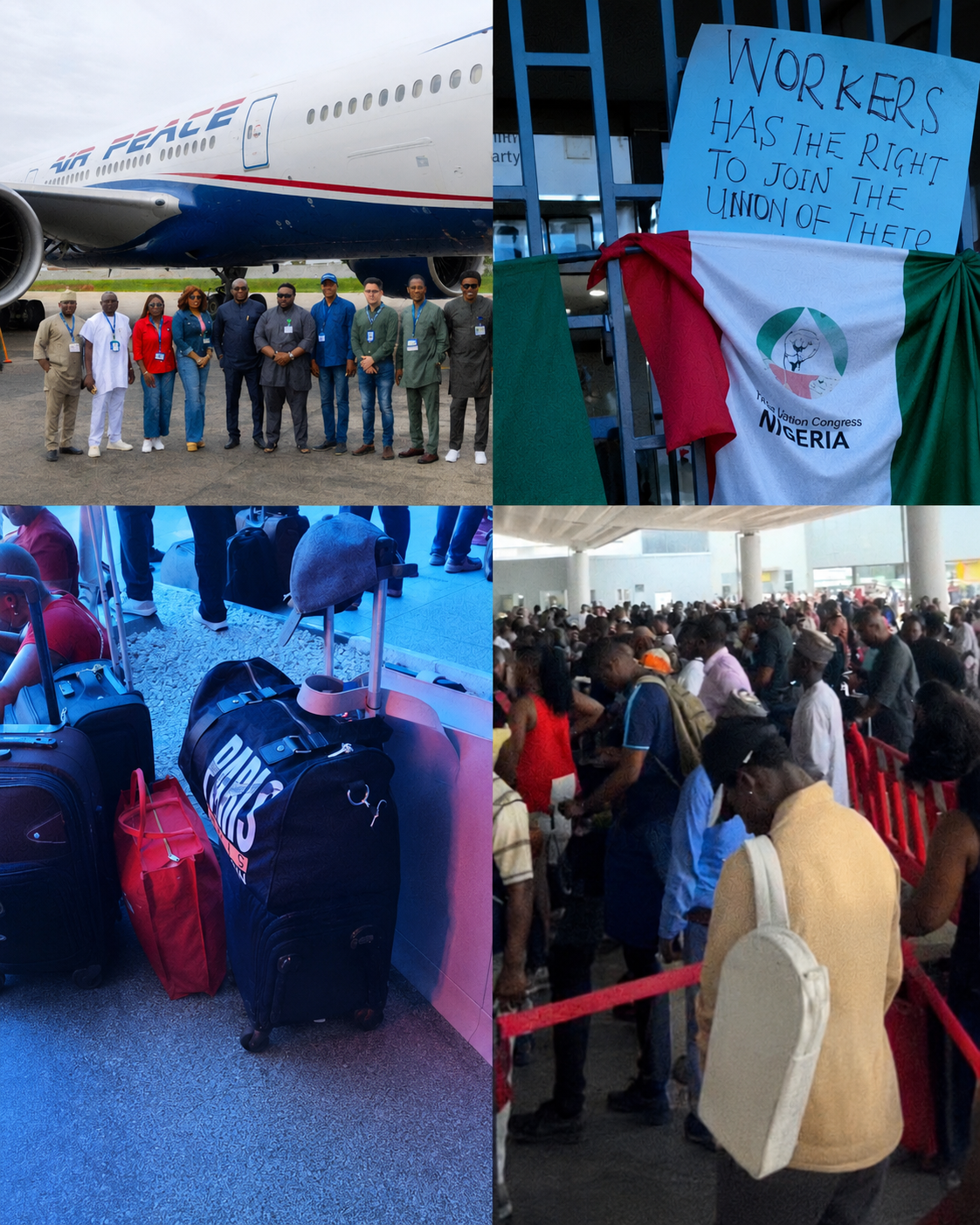
LAGOS/ABUJA — Flight operations of Nigeria’s largest airline, Air Peace, were heavily disrupted on Tuesday, 11 August 2026, after aviation labour unions barricaded its departure terminals at the Murtala Muhammed International Airport in Lagos and the Nnamdi Azikiwe International Airport in Abuja.
Members of the National Union of Air Transport Employees (NUATE), the Air Transport Services Senior Staff Association of Nigeria (ATSSSAN), and the National Association of Aircraft Pilots and Engineers (NAAPE), supported by the Nigeria Labour Congress (NLC) and Trade Union Congress (TUC), began the action in the early hours. Access to check-in and departure areas was restricted, preventing scheduled flights from departing and leaving hundreds of passengers stranded. Reports indicate more than 70 domestic and regional flights were cancelled or delayed, with knock-on effects felt on the airline’s network.
The unions said the picketing followed earlier notices and stemmed from two main issues: the alleged failure of Air Peace (and other domestic operators) to fully remit the statutory five per cent Ticket Sales Charge (TSC) and related levies collected from passengers and due to the Nigeria Civil Aviation Authority (NCAA) and other aviation agencies; and claims that the airline has restricted or discouraged staff from freely joining trade unions. Unions argue non-remittance of the charges undermines funding for aviation agencies and c1ollective bargaining agreements. Figures for outstanding amounts attributed to Air Peace have varied in reports (with some circulating claims around ₦15–25 billion); the NCAA has previously indicated structured repayment arrangements exist for historical debts while current remittances continue.
Air Peace staff have publicly rejected the action. A spokesman for the workers, Comrade Aminu Suleiman, said employees had dissociated themselves, stating that in the 12 years since the airline began operations they have enjoyed regular salaries, HMO benefits, and involvement in decision-making. They maintain they do not require external union representation and cite Section 40 of the 1999 Constitution guaranteeing freedom of association. Workers accused the unions of seeking to create division between staff and management. Reports also noted resistance by airline personnel and that Air Peace buses were deployed in a manner that blocked a taxiway in Lagos during the escalation. One report alleged that some Air Peace workers were assaulted by picketers for refusing to join the unions.
In a statement, Air Peace apologised to affected passengers, describing the disruptions as temporary and caused by circumstances beyond its control. The airline confirmed that entrances to its terminals at Murtala Muhammed Airport Terminal 1 (Alpha and Zulu) and Terminal 2 in Lagos, as well as the terminal in Abuja, had been barricaded, preventing departures and significantly affecting travellers across its network. It said passengers scheduled for later flights were being contacted with updates.
The Nigeria Civil Aviation Authority (NCAA) confirmed the incident was related to the industrial action and appealed to the unions to suspend the picketing to allow dialogue. The authority noted that a meeting convened by the Minister of Aviation and Aerospace Development had earlier been hindered by the non-attendance of airline operators and expressed hope for a swift resolution.
The action is the latest chapter in a protracted dispute involving domestic airlines, aviation agencies, and organised labour over the collection and remittance of the 5% TSC — a statutory charge long criticised by operators as burdensome amid high operating costs — and questions of workers’ freedom to organise. Passengers were advised to monitor airline communications for rebooking and further information as the situation developed.