

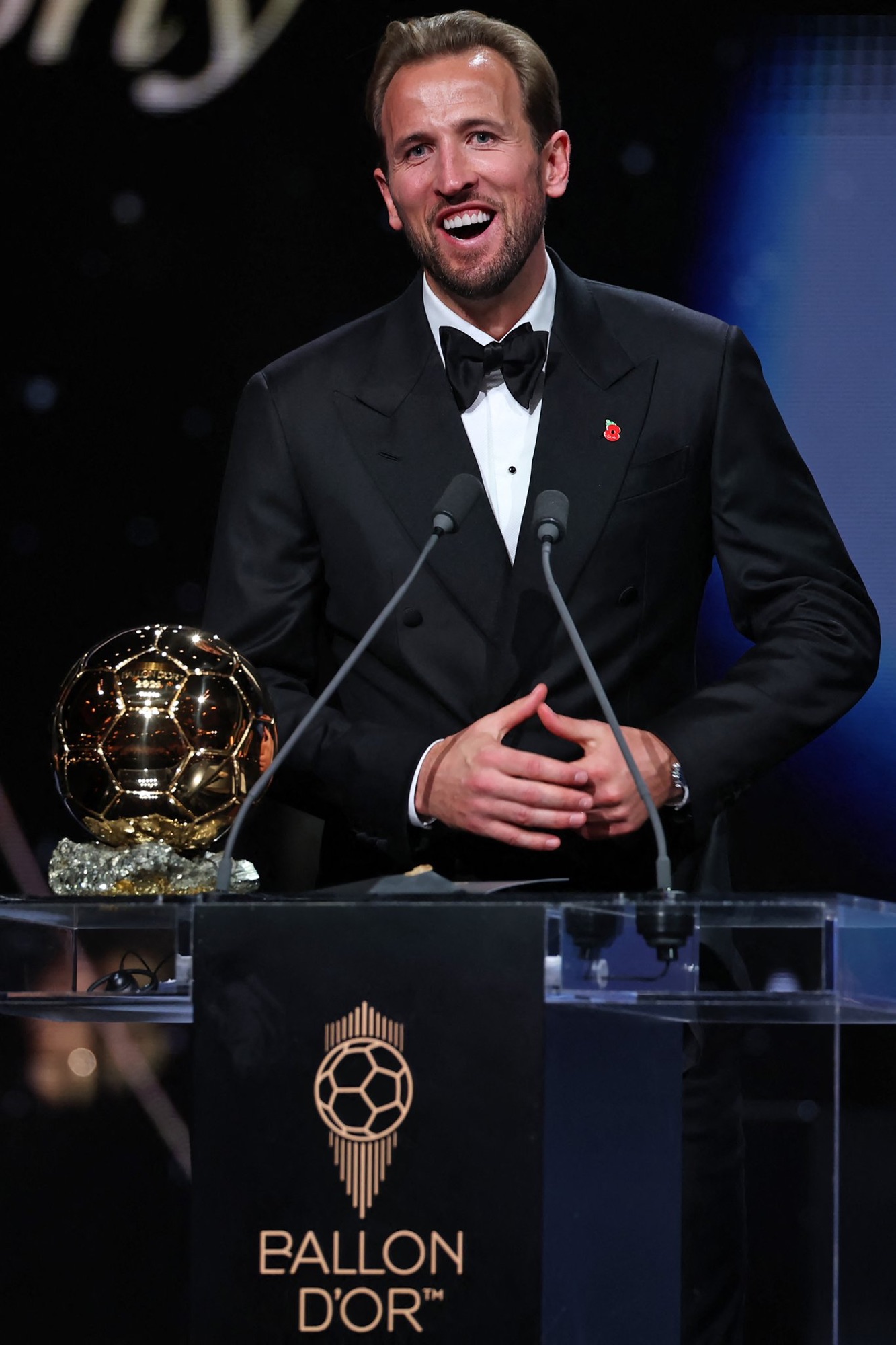
Bayern Munich and England captain Harry Kane has won the 2026 Men’s Ballon d’Or, becoming the first Englishman to claim football’s most prestigious individual award since Michael Owen in 2001.
The 33-year-old was presented with the trophy at a ceremony held at the London Palladium on Monday evening, ahead of Real Madrid’s Kylian Mbappé in second place and Barcelona’s Lamine Yamal in third. Rodri and Lionel Messi completed the top five. Kane also collected the Gerd Müller Trophy for the season’s top scorer earlier in the night.
“Wow, wow, wow! I am almost speechless. Being here in London has made it extra special,” Kane said upon receiving the award.
He joins Stanley Matthews (1956), Bobby Charlton (1966), Kevin Keegan (1978 and 1979), and Owen as the fifth English winner of the men’s prize. Kane is also the first Bayern Munich player to win the Ballon d’Or since Karl-Heinz Rummenigge in 1981.
The award recognises performances across the 2025/26 season (roughly August 2025 to July 2026). Kane delivered the most prolific campaign of his career, scoring 73 goals and providing eight assists in 65 appearances for club and country.
Bayern Munich (61 goals in 51 matches):
• Bundesliga: 36 goals in 31 appearances — top scorer for a third consecutive season and winner of the European Golden Shoe.
• UEFA Champions League: 14 goals in 13 appearances (Bayern reached the semi-finals).
• DFB-Pokal: 10 goals in 6 appearances, including a hat-trick in the final.
• Super Cup: 1 goal in 1 appearance.
England (12 goals in 14 matches):
• FIFA World Cup 2026: 6 goals in 7 matches as England reached the semi-finals.
• Additional goals came in World Cup qualifiers and friendlies. Kane also overtook Gary Lineker to become England’s all-time leading scorer in World Cup history.
Bayern completed a domestic double (Bundesliga and DFB-Pokal) plus the Super Cup. Kane’s club total of 61 goals set a modern-era record for a Bayern player in a single season and ranked among the highest individual tallies in European top-flight history this century, trailing only Lionel Messi’s 82-goal campaign in 2011/12.
Despite Bayern’s Champions League semi-final exit and England’s World Cup semi-final defeat, Kane’s sustained excellence across all competitions proved decisive for voters. He had finished outside the top 10 in previous Ballon d’Or rankings before this breakthrough year.
Spain’s Alexia Putellas won the Women’s Ballon d’Or for the third time. Other major awards included Lamine Yamal as Men’s Young Player of the Year and Unai Simón as Men’s Goalkeeper of the Year.
Kane’s triumph ends a 25-year wait for English football and cements a career defined by consistent goalscoring excellence, now fully recognised on the global stage.