

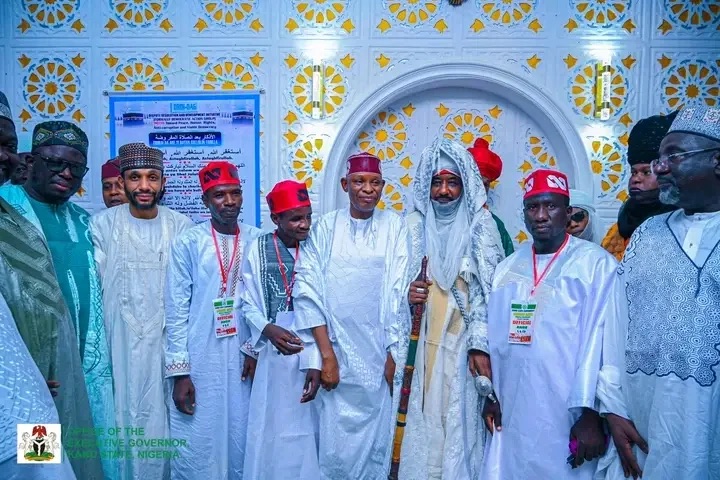
In early August 2026, Kano State Governor Abba Kabir Yusuf oversaw a large-scale mass wedding in which 1,500 couples were married under a government-sponsored programme known as Auren Gata. The main central ceremony took place on Friday, 7 August 2026, at the Emir’s Palace in Kano, with simultaneous events across the state’s 44 local government areas. A reception and distribution of support items followed on Saturday.8
The initiative, coordinated by the Kano State Hisbah Board, targeted low-income and vulnerable residents, including widows, divorcees, orphans, spinsters, and bachelors who struggle with the high costs of marriage in the predominantly Muslim northern Nigerian state. Officials described it as fulfilling a campaign promise from Yusuf’s 2023 election bid and as a social welfare measure to ease financial burdens, promote stable families, discourage immoral practices, and support dignified family life in line with Islamic principles and local culture. This was the second major mass wedding under Yusuf’s administration (following one involving about 1,800 couples in 2023).
Around 5,000 couples applied. After screening, 1,500 couples (3,000 individuals) were selected. The state government spent N1.5 billion (approximately $1 million) on the programme.0
Support packages generally included:
- Medical screening for all participants (HIV, hepatitis, genotype compatibility, pregnancy tests, and related checks) plus counselling.
- Cash support for each bride, commonly reported as N200,000 covering dowry and start-up capital for small businesses (some official statements broke this down as N100,000 dowry + N100,000 empowerment grant).
- Household essentials such as beds, mattresses, bedsheets, pillows, wardrobes, dressing mirrors, blankets, centre rugs, and food items.
- Additional items for grooms in some reports (e.g., fabric, caps, rice, and cooking oil).36
The Hisbah Board oversaw vetting to confirm genuine intent and compliance with religious and legal requirements. Ceremonies followed Islamic rites, with Governor Yusuf representing the first groom (or serving as guardian for the grooms) and Emir of Kano Muhammadu Sanusi II representing the bride(s). The Chief Imam of Kano, Professor Sani Zahraddeen, offered prayers.
One widely reported case involved Haruna Bashir, a widower whose wife, Fatima Abubakar, and six children were killed in an attack on their home in Dorayi Chiranchi Quarters, Kano, in January 2026. Bashir remarried (to Nabila Kabiru Yunusa or Rahinatu Jamilu-Yunusa, according to varying reports) under the programme. Beyond the standard package, the state provided him with a house in Amana City and sponsorship for Umrah and Hajj as part of efforts to help him rebuild his life. Hisbah officials noted he had largely withdrawn from social interaction after the tragedy.
Other beneficiaries included people with disabilities, those delayed by economic hardship or inflation, widows with children, and individuals seeking second marriages. Governor Yusuf called the programme a “bold social intervention aimed at restoring hope, strengthening families and promoting moral values.” He urged the newlyweds to practice patience, justice, mutual respect, and tolerance, framing marriage as an act of worship. The Emir similarly stressed faith, patience, and compassion as foundations for peaceful homes and a stable society.
Mass weddings of this type have a longer history in Kano (with annual traditions noted in some reporting since around 2012) and are common in parts of northern Nigeria as a response to poverty and cultural expectations around marriage. The Hisbah’s role includes both facilitation and moral oversight. Demand remains high due to the rising costs of establishing a household.