

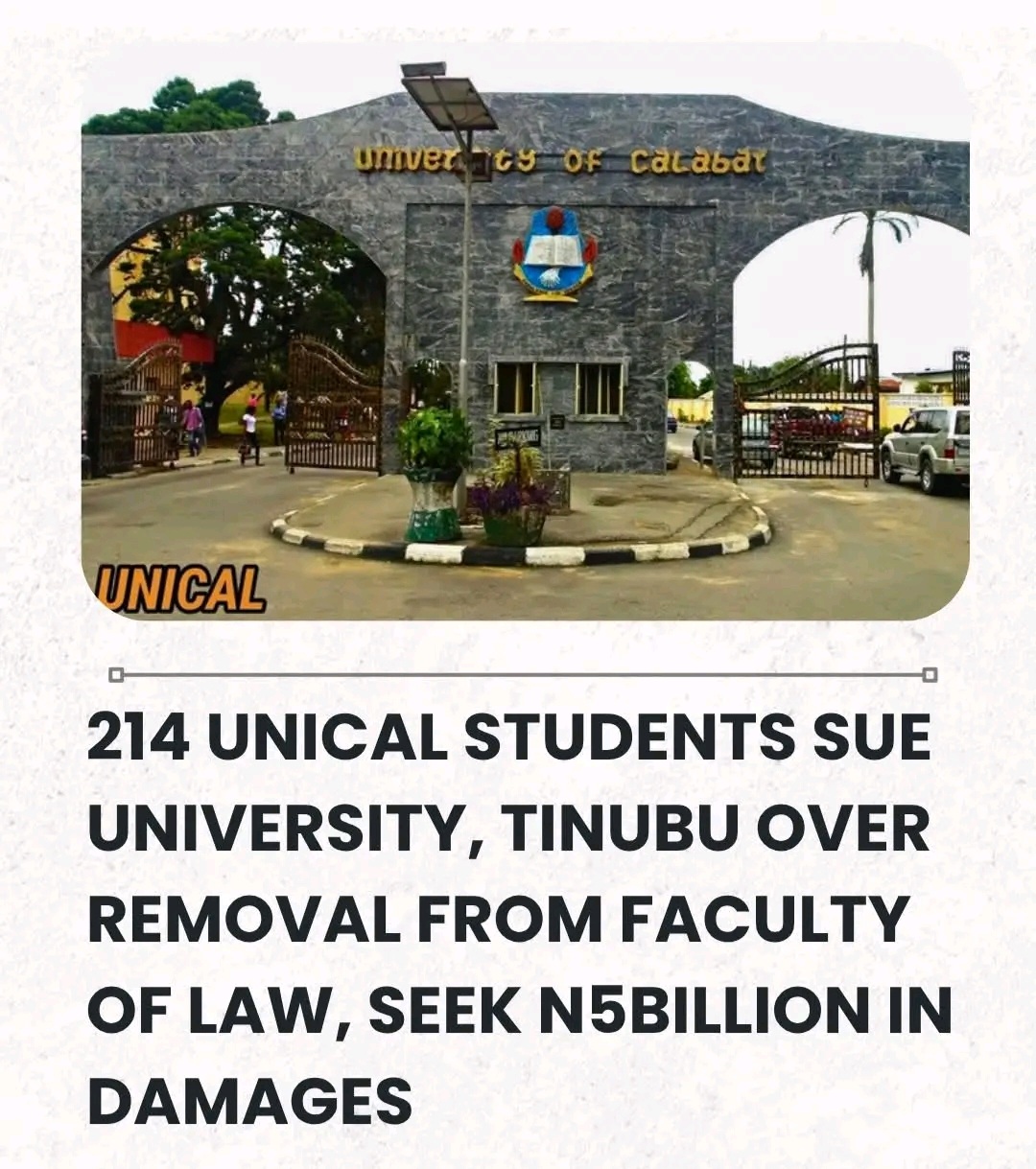
Cross River – Over 200 second-year Law students of the University of Calabar (UNICAL) have dragged the institution, its Vice-Chancellor, the Registrar and President Bola Tinubu to the Federal High Court in Abuja.
The 214 students, represented by OBA Attorneys (led by Okpi Bernard Adaafu, Esq.), filed the suit on 12 August 2026. They are challenging the university’s decision to remove them from the Faculty of Law and return them to their original departments after nearly two to three years of study. They are also demanding ₦5 billion in general damages.
### Background
The controversy began earlier this month. UNICAL management, after reviewing admission records, directed the 214 students (out of 435 in the LL.B II class) to return to the departments into which they were originally admitted. The university stated that only 221 students were officially admitted into the Law programme, while the others had entered via departmental transfers. It argued that the affected students would not be eligible for the Nigerian Law School under their current status.
The university temporarily locked the students’ academic portals to facilitate the transfer and offered either a full refund of 2025/2026 tuition fees or free tuition for the 2026/2027 session in their original departments.
### Students’ Claims
In an affidavit supporting the suit, one of the claimants, Ogana Lawrence Lukpata, stated that he and the other 213 students were admitted into the Faculty of Law between the 2023/2024 and 2024/2025 academic sessions. They paid acceptance and school fees for almost three academic years, registered for Law courses, attended lectures, completed continuous assessments, sat examinations, and progressed from 100 Level to 200 Level (with some reaching 300 Level).
They also completed JAMB regularisation as directed by the university. Problems reportedly arose after the current Vice-Chancellor, Prof. Offiong Offiong, assumed office in December 2025, succeeding Prof. Florence Obi. The students claim the new VC declined to complete earlier regularisation documents processed under his predecessor, forcing them to restart the process and pay again.
On 5 August 2026, at a meeting in the Senate Chamber, the Vice-Chancellor announced the removal of the 214 students and directed their return to former departments. Their portals were then locked, cutting off access to results, transcripts and learning platforms. The students say they received no prior query, notice of allegation, hearing or opportunity to defend themselves, and none had been investigated or found guilty of any misconduct.
### Reliefs Sought
The students are asking the court for:
– A declaration that their admissions, fee payments, course registrations, examinations and JAMB regularisation created valid and binding contracts with the university.
– A declaration that the Vice-Chancellor cannot arbitrarily invalidate official acts and approvals made under his predecessor (citing the doctrine of executive continuity and administrative estoppel).
– A declaration that their removal and the locking of their portals violate Section 18 of the University of Calabar Act and their constitutional right to fair hearing.
– An order setting aside the decision and directing their continued study in the Faculty of Law.
– A permanent injunction restraining the university from demoting, transferring, ejecting them or restricting their portal access.
– An order directing President Tinubu (as the appointing authority for the VC) to exercise supervisory powers over the university’s management.
– ₦5 billion in general damages.
They have also filed a motion seeking interim orders to restore full portal access and restrain the university from implementing the 5 August directive while the substantive suit is pending.
The case, handled by a team of lawyers including Okpi Bernard Adaafu, Esq., Michael William Aniefiok, Esq., Eta Agbor Agwu, Esq., Idiku Elizabeth Ebeyin, Esq., Obi Ben Otu, Esq., Nwogu Excel Chimankpam, Esq., and Lura Pitiko Jirji, Esq., highlights ongoing tensions around admission processes and student rights in Nigerian universities.

