

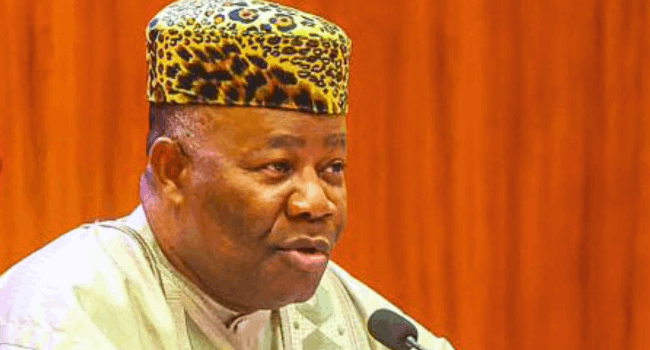

Senate President Godswill Akpabio has opposed moves to remove criminal penalties for attempted suicide in Nigeria, insisting that people who survive such incidents should remain liable to imprisonment.
Akpabio made his position known during Tuesday’s plenary session, October 13, 2026, as the Senate considered a bill seeking to decriminalise attempted suicide and establish a national framework for prevention, treatment and rehabilitation.
The Senate President argued that removing the existing penalties could encourage the act, maintaining that attempted suicide should continue to attract legal consequences.
His position emerged during deliberations on a bill sponsored by Senator Asuquo Ekpenyong, who represents Cross River South Senatorial District.
The proposed legislation seeks to shift Nigeria’s response to attempted suicide from criminal prosecution towards medical intervention, psychological support and rehabilitation for survivors.
Despite Akpabio’s opposition, the bill secured the Senate’s approval for second reading, allowing it to proceed to further legislative consideration.
Bill seeks to address conflict in existing laws
Presenting the proposal, Ekpenyong argued that Nigeria’s legal framework contains conflicting approaches to attempted suicide.
He noted that provisions of the Criminal Code and Penal Code criminalise attempted suicide, while the National Mental Health Act recognises psychiatric emergencies as requiring appropriate medical intervention.
According to the senator, retaining criminal sanctions could discourage people experiencing psychological distress from seeking assistance and compel families to conceal incidents for fear of prosecution.
He maintained that survivors should receive timely medical assessment, treatment and continuing support rather than face imprisonment.
The proposed framework also seeks to strengthen suicide prevention through public awareness, crisis-response services, professional training and improved collection of national data on suicide-related incidents.
Ekpenyong stressed that removing criminal penalties would not, on its own, resolve the problem, arguing that effective implementation would require accessible mental healthcare and sustained support systems.
Senators call for a health-centred approach
Contributing to the debate, Senator Dayo Faduyile, who represents Ondo South and is a medical doctor, argued that attempted suicide should be treated primarily as a medical emergency.
He maintained that people who survive suicide attempts may require urgent psychological evaluation and treatment, adding that imprisonment would not necessarily address the underlying factors that contributed to their distress.
Senator Abdul Ningi of Bauchi Central also supported a broader examination of the circumstances surrounding suicide attempts, emphasising the importance of medical intervention and understanding the challenges faced by affected individuals.
However, Senate Leader Opeyemi Bamidele raised questions about the proposed legislation’s nationwide application, noting the need to examine the relationship between federal criminal laws and the legal frameworks applicable in individual states.
Akpabio also called for the State Houses of Assembly’s involvement during the public hearing, arguing that the proposed reforms’ legal implications required careful consideration.
Following its passage for second reading, the bill was referred to the Senate Committees on Health (Secondary and Tertiary) and Judiciary, Human Rights and Legal Matters for further legislative work.
The committees are expected to examine the proposal and consider relevant legal, medical and public-health concerns before further action by the Senate.
Under the existing legal framework, attempted suicide remains a criminal offence under applicable provisions of the Criminal Code and Penal Code, with penalties that can include imprisonment.
The proposed legislation seeks to change that approach by prioritising prevention, treatment and rehabilitation.
The Senate’s decision to advance the bill represents a step in the legislative process; it does not mean the proposed reforms have received final approval or taken effect as law.
The debate has brought renewed attention to the question of whether survivors of suicide attempts should face criminal punishment or receive medical and psychological care as part of a national suicide-prevention strategy.