

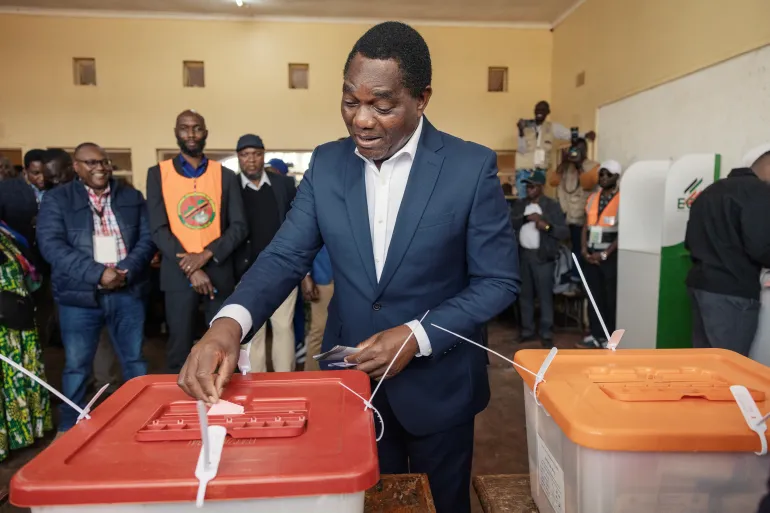
LUSAKA — Zambia’s President, Hakainde Hichilema, has secured a second five-year term in office after defeating his closest challenger, Brian Mundubile, in the country’s August 13 presidential election.
The Electoral Commission of Zambia announced the result in the early hours of Tuesday, declaring Hichilema the winner after he secured about 61.4 per cent of the valid votes, while Mundubile garnered approximately 38 per cent.
“I therefore declare Hichilema Hakainde S to be president-elect of the Republic of Zambia this 18th day of August, 2026,” the commission’s chairperson, Mwangala Zaloumis, announced.
The victory marks Hichilema’s seventh attempt at the presidency and extends his tenure for another five years. Mundubile, who contested under the National Reconciliation Party for Unity and Prosperity, was making his first bid for the country’s highest political office.
Following the declaration, jubilant supporters of Hichilema’s United Party for National Development took to the streets of Lusaka, dressed predominantly in the party’s red colours. They sang, danced and celebrated the outcome with firecrackers.
Hichilema, 64, in his reaction to the result, expressed appreciation to voters for renewing their confidence in his administration.
He said he was “truly humbled by the trust” placed in his leadership, while assuring citizens who voted against him that his government would continue to serve them.
Mundubile had yet to publicly respond to the declaration at the time of filing this report.
The election was, however, not without controversy. Tensions rose in the final stages of the electoral process following a security operation on election night in which 11 people, including prominent opposition figures, were arrested.
Government authorities said the operation was aimed at disrupting alleged militia activities and claimed that those detained were found with military-grade weapons. Mundubile’s party disputed the government’s account, alleging that security forces raided the opposition leader’s residence and that a lawmaker was injured during the incident.
Vote counting was also temporarily suspended after reports of attacks on electoral personnel and the removal of ballot papers from some locations.
Mundubile subsequently raised concerns over alleged attempts to manipulate results from polling stations and called for an independent investigation. Hichilema’s camp dismissed the allegations.
International observers acknowledged that voting was generally peaceful but expressed concerns about the wider electoral environment.
The European Union’s election observation mission said restrictions on fundamental freedoms, changes to electoral laws and unequal campaign conditions affected the fairness of the contest.
About five million voters participated in the election in the southern African nation, which has a population of roughly 22 million and is one of Africa’s leading copper producers.
Despite the disputes surrounding the 2026 election, Zambia has maintained a relatively strong democratic tradition. Since the restoration of multiparty politics in 1991, successive changes of government have taken place through elections.