

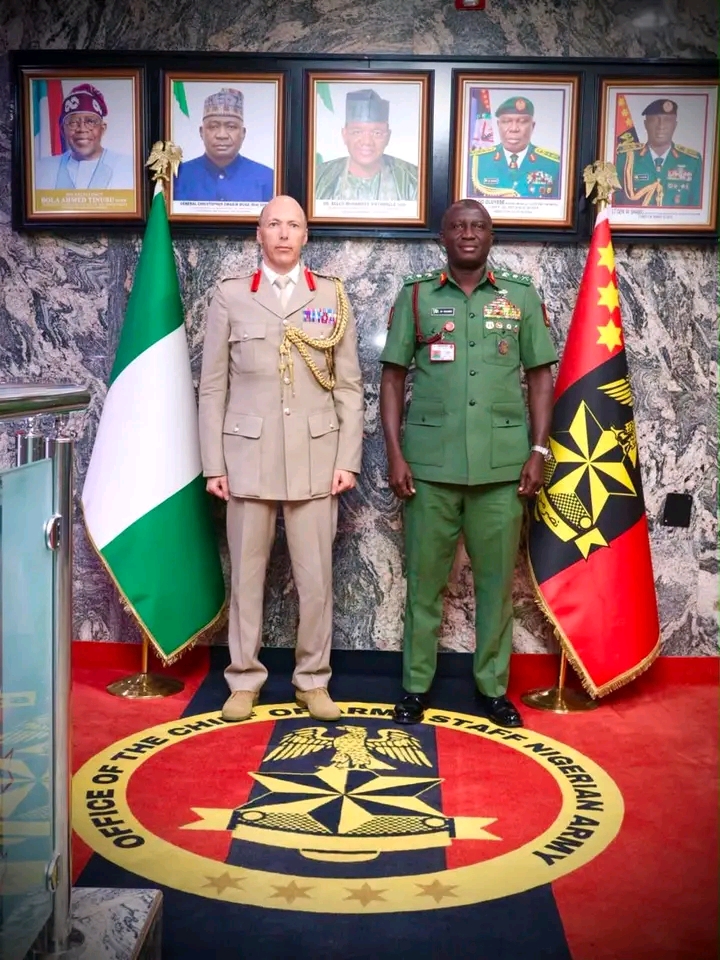

ABUJA — The Nigerian Army and the United Kingdom have agreed to deepen defence cooperation, with stronger intelligence, specialised training, air defence and counter-drone capabilities at the centre of the renewed partnership.
The Chief of Army Staff, Lt. Gen. Waidi Shaibu, disclosed this on Tuesday when he received the British Defence Adviser to Nigeria, Brig. Tom Harper, MBE, on a courtesy visit to the Army Headquarters, Abuja.
Shaibu said the partnership with the UK remained critical to transforming the Nigerian Army into a more adaptable, combat-ready and resilient force capable of tackling emerging national and regional security threats.

He said the collaboration would strengthen operational effectiveness, force protection, intelligence gathering, specialised training and institutional capacity.
The Army chief said sustained engagement with trusted international partners was necessary to accelerate the Army’s transformation, particularly in capability development, professional military education, technology integration and modern approaches to asymmetric warfare.
Shaibu identified asymmetric warfare and operations in difficult terrain, especially in the North-East, as major challenges confronting the military.
He said the Army needed enhanced intelligence, surveillance and reconnaissance, technical intelligence, aviation capability and round-the-clock domain awareness down to the battalion level to effectively confront the threats.
The COAS also pointed to the expansion of the Army from eight to 12 divisions, saying the development would require increased investment in advanced training, instructor development and Special Forces capabilities.
He specifically called for enhanced capacity at the Doma training facility.
Shaibu further disclosed efforts to institutionalise operational lessons and preserve military heritage by incorporating historic campaigns, including the Longest Advance, into command curricula and digitising military archives.
On his part, Harper reaffirmed the UK’s commitment under the Security and Defence Partnership to supporting Nigeria’s efforts to strengthen its military capabilities.
The British Defence Adviser disclosed plans to expand regional train-the-trainer programmes covering combat tactical drills, casualty care and advanced patrolling.

He said future Operation Hadin Kai training cohorts would include personnel from Niger, Cameroon and Chad alongside Nigerian troops.
According to him, the arrangement would improve interoperability among the participating countries and strengthen regional capacity to confront common security threats.
Harper also outlined proposed British support for the establishment of a reference Forward Operating Base within a cantonment environment.

Other areas of proposed support include counter-unmanned aerial systems and the expansion of tactical Intelligence, Surveillance and Reconnaissance capabilities to brigade level.
The two sides also discussed defence procurement and capability development, including air defence systems, possible transfers of protected mobility vehicles and specialised ammunition support.
The Army said the broader partnership was designed to strengthen Nigeria’s ability to anticipate, deter and respond decisively to emerging security threats.