


Government faces pressure to address rising living costs as labour deadline approaches
The Federal Government has called for a realistic balance between workers’ demands for improved earnings and the country’s financial capacity, amid growing pressure from organised labour over the rising cost of living.
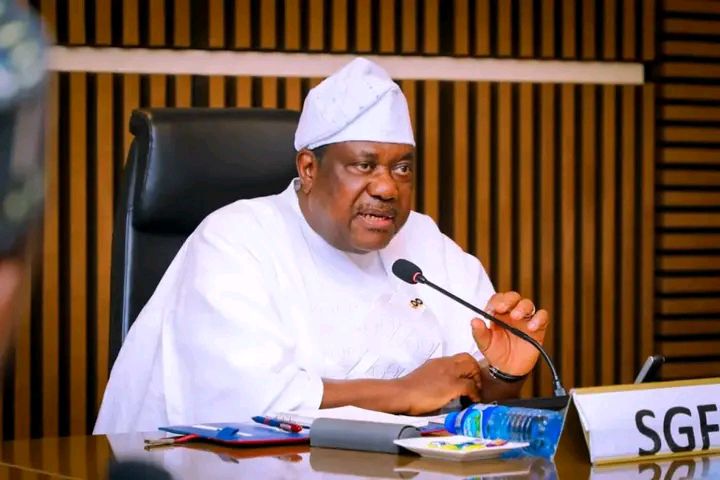
The position was conveyed by the Secretary to the Government of the Federation, Senator George Akume, on Monday, October 19, 2026, during a board retreat of the National Salaries, Incomes and Wages Commission in Abuja.
The development comes as the Nigeria Labour Congress (NLC) presses the government to address a series of demands within a two-week ultimatum that commenced on October 9.
The labour organisation is seeking a reduction in petrol prices, the commencement of negotiations for a new national minimum wage, tax relief for workers and the implementation of outstanding agreements affecting public-sector and health-sector employees.
The NLC has argued that the existing minimum wage of ₦70,000 has lost much of its purchasing power because of rising prices, currency depreciation and increasing household expenses.
According to the union, many workers are struggling to meet essential needs, including food, transportation, accommodation, healthcare and education.
The Congress has consequently called for negotiations towards a new minimum wage to begin before the end of October, alongside immediate measures to ease the financial pressure on employees.
It has also asked the Federal Government to reduce petrol prices to the levels prevailing when the current minimum wage was signed into law in 2024.
In its earlier response to the union, the Federal Government maintained that the current national minimum wage would ordinarily become due for review in June 2027, based on the statutory three-year review cycle.
The government argued that commencing a fresh wage review before the stipulated period would be premature, while assuring labour representatives of its willingness to engage on other outstanding issues.
The administration also pointed to existing economic support measures, including the Presidential Compressed Natural Gas Initiative and food-security interventions, as part of its efforts to ease the effects of economic hardship.
However, the NLC has rejected the argument for delaying the negotiation process, maintaining that beginning discussions do not amount to immediately implementing a new wage.
The disagreement has heightened concerns about a possible confrontation between the government and organised labour if both sides fail to reach an understanding within the ultimatum period.
The NLC has warned that it could take further action through its relevant organs if its demands are not addressed. Although the union has threatened escalation, a specific nationwide strike date has not been established in the reports reviewed.
The dispute also includes demands for the implementation of agreements involving the Joint Health Sector Unions and the Assembly of Healthcare Professionals, as well as issues raised by the Joint Public Sector Negotiating Council.
As the deadline approaches, attention is focused on whether the Federal Government will introduce additional relief measures or agree to begin discussions on a new wage arrangement.
The central challenge for both parties is to find a workable solution that addresses workers’ declining purchasing power while taking account of the government’s fiscal obligations.
The outcome of the negotiations could have significant implications for industrial relations, public-sector productivity and the financial wellbeing of Nigerian households.