

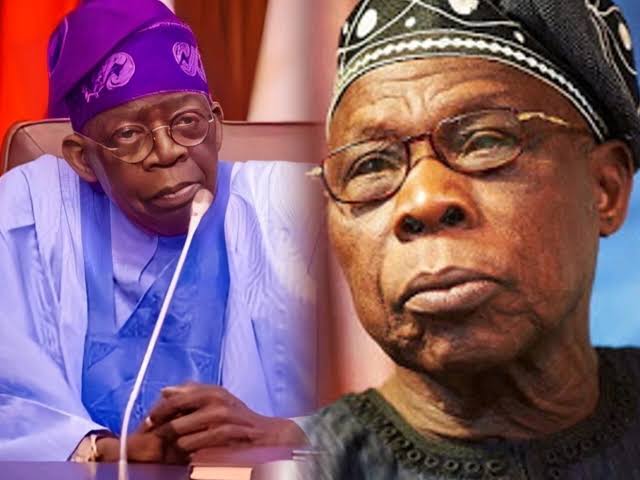
Former President Olusegun Obasanjo has questioned the effectiveness of President Bola Tinubu’s economic policies, arguing that the sharp depreciation of the naira and the removal of petrol subsidies have placed additional pressure on Nigerian households.
Obasanjo made the remarks on Wednesday, October 21, during an interview at the Financial Times Africa Summit in London, where he assessed Nigeria’s economic direction and challenged the argument that the president should be given another term to consolidate his reforms.
The former president argued that the decline in the naira’s value against the United States dollar had weakened citizens’ purchasing power and contributed to the country’s poverty challenges. He cited the movement of the exchange rate from approximately ₦500 to the dollar to about ₦1,500, describing the change as a major setback for ordinary Nigerians.
The former president also questioned whether extending the current administration’s tenure would necessarily improve the economy, arguing that the consequences of the reforms should be assessed against their effects on citizens’ welfare.
He challenged the notion that the government needed additional time to complete its economic programme, asking what tangible improvements Nigerians could expect from policies that, in his assessment, had increased their financial difficulties.
Obasanjo stressed that his criticism was directed at the administration’s economic decisions rather than simply at Tinubu’s position as president. He maintained that the central issue was whether the policies were serving the interests of the Nigerian people.
Tinubu announced the removal of the petrol subsidy shortly after assuming office in May 2023. His administration subsequently introduced foreign-exchange reforms intended to reduce market distortions and allow the naira to trade more freely.
The measures were presented by the government as necessary steps towards improving fiscal sustainability, attracting investment and addressing longstanding weaknesses in the economy.
However, the changes were accompanied by higher fuel and transportation costs, increased prices for imported goods and persistent pressure on household budgets.
Obasanjo argued that corruption and financial leakages in the petroleum sector should have received greater attention, suggesting that tackling those problems could have reduced the burden associated with the subsidy system.
His position adds to the continuing debate over whether the reforms’ long-term economic objectives justify the immediate costs borne by citizens.
Beyond his criticism, Obasanjo identified increased domestic production, tighter control of public expenditure and stronger anti-corruption measures as priorities for improving Nigeria’s economic prospects.
He argued that the country needed to address waste and corruption while expanding its capacity to produce goods and services, rather than depending excessively on imports.
The former president also compared Nigeria’s currency performance with developments in Ghana, using the neighbouring country as an example during his assessment of regional economic management. However, exchange-rate movements alone do not establish which economy is performing better; inflation, productivity, employment, public finances and household incomes must also be considered.
Obasanjo’s intervention has renewed attention on the social consequences of the Tinubu administration’s reforms as political parties prepare for the 2027 general election.
The administration has defended its economic programme as a necessary restructuring exercise, while critics continue to question how quickly the benefits will reach ordinary citizens.
The central issue remains whether improvements in fiscal management, investment conditions and other macroeconomic indicators can translate into stronger purchasing power, more jobs and lower living costs.
For millions of households, the practical measure of economic recovery will be whether incomes can keep pace with the cost of food, transportation, housing and other essential needs.