

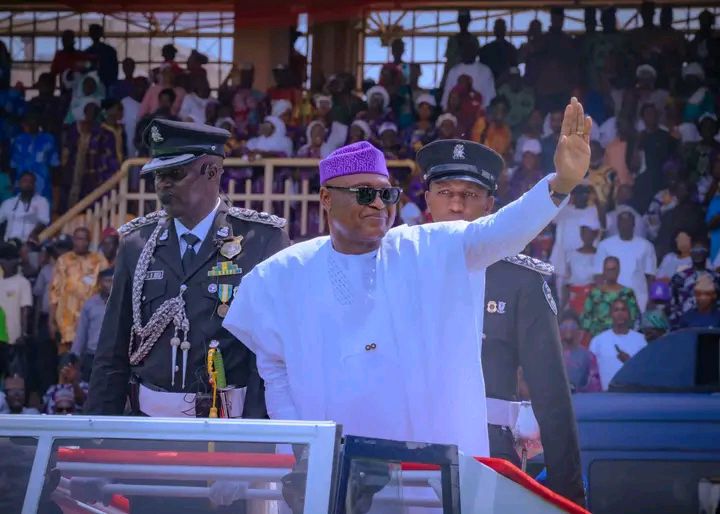
Shettima, Akpabio, governors, traditional rulers attend inauguration
ADO-EKITI — Ekiti State Governor, Biodun Oyebanji, has commenced his second four-year tenure alongside his deputy, Monisade Afuye, following their inauguration at a ceremony attended by prominent political leaders and traditional rulers.

The swearing-in ceremony took place on Friday, October 16, 2026, at the Ekiti Parapo Pavilion in Ado-Ekiti, the state capital, marking the beginning of another term for the All Progressives Congress (APC) administration.
The Chief Judge of Ekiti State, Justice Lekan Ogunmoyе, administered the oaths of office to the governor and his deputy.

Vice-President Kashim Shettima represented President Bola Tinubu at the event, which attracted Senate President Godswill Akpabio, Deputy Senate President Barau Jibrin, several state governors, ministers, former governors and other dignitaries.
Traditional rulers, including the Ooni of Ife, Oba Adeyeye Ogunwusi, also attended the ceremony.
In his inaugural address, Oyebanji said his renewed mandate would be used to consolidate previous achievements and intensify efforts to improve the welfare of Ekiti residents.
He called for the cooperation of citizens within the state and in the diaspora, emphasising that sustainable development would require contributions from people across political, professional and social backgrounds.
The governor identified employment generation, agriculture, electricity, education, healthcare, infrastructure and skills development as important areas of focus for his administration.
He also stressed that government projects must deliver measurable benefits to households, businesses, farmers and young people rather than merely add to the number of completed infrastructure projects.
According to him, the effectiveness of his second administration would be judged by improvements in living standards, expanded economic opportunities and the ability of public investments to address the needs of ordinary citizens.
Oyebanji further promised to strengthen the relationship between education and employment by promoting practical skills, innovation and enterprise.
He urged professionals and Ekiti indigene living outside the state to contribute their expertise, investments and networks to the state’s development.

Delivering President Tinubu’s message, Shettima congratulated the governor and his deputy on their re-election and urged them to approach the new tenure with greater commitment to public service.
The Vice-President said the renewed mandate came with increased expectations, calling on the administration to improve public services, create opportunities for young people and ensure that government policies addressed the needs of underserved communities.
He also expressed confidence that the governor would build on the work of his first term while maintaining an inclusive approach to governance.
President Tinubu, through his representative, commended the people of Ekiti for renewing the administration’s mandate and encouraged the governor to sustain public confidence through effective leadership and responsible management of public resources.
The President’s message also highlighted the importance of ensuring that the benefits of government programmes reached communities and translated into meaningful improvements in residents’ lives.
Oyebanji’s re-election marks a significant development in Ekiti State’s political history, as he became the first governor to secure consecutive terms since the state’s creation in 1996, according to reports by the state government and other media organisations.
His return to office followed the June 20, 2026, governorship election, in which he secured another mandate on the APC platform.
The inauguration attracted political leaders from different parts of the country, including Lagos State Governor Babajide Sanwo-Olu, Imo State Governor Hope Uzodimma and Kwara State Governor AbdulRahman AbdulRazaq.
Their presence reflected the national political significance attached to the ceremony and the continuation of the APC administration in Ekiti.
As the governor begins his second term, attention is expected to shift from campaign commitments to implementation and accountability.
Residents will be watching for tangible improvements in job creation, electricity supply, road infrastructure, healthcare, education and support for small businesses.
The administration will also face the task of responding to economic pressures affecting families, particularly the cost of food, transportation and other essential services.
Ultimately, the success of Oyebanji’s renewed mandate will depend on his government’s ability to translate its development agenda into practical results across Ekiti’s 16 local government areas.
For the governor and his team, the second term presents an opportunity to consolidate existing programmes, correct shortcomings and demonstrate that the confidence placed in them by voters can produce lasting benefits for the state.