

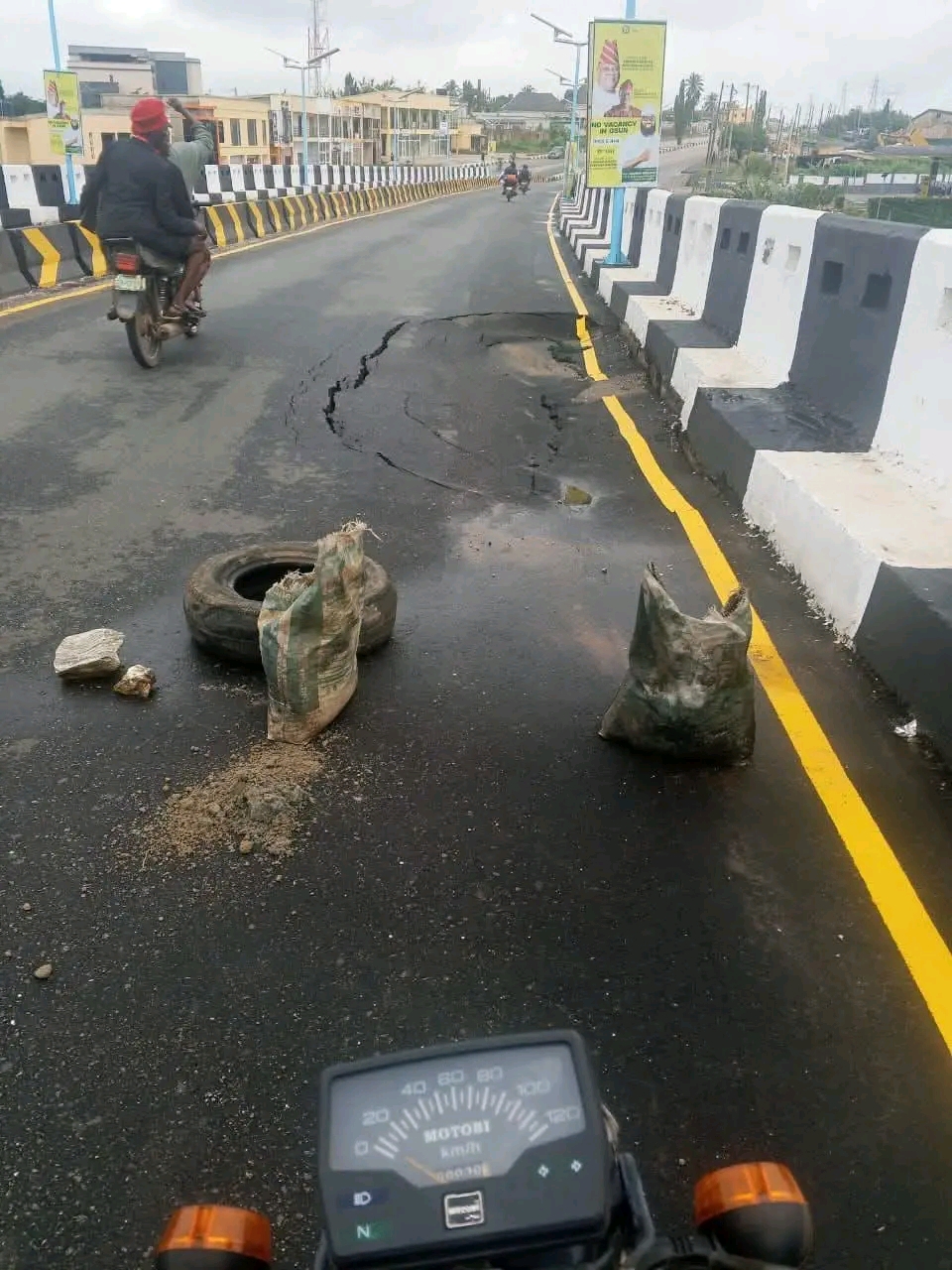
OSOGBO, Nigeria — Concerns have emerged over the structural condition of the newly commissioned LAMECO Flyover in Osogbo, Osun State, after a section of the bridge developed visible damage barely three weeks after it was opened to the public.The affected portion of the 672-metre flyover reportedly caved in during the early hours of Friday following a prolonged downpour that lasted for nearly eight hours across the Osun State capital. The incident left one lane of the bridge with a noticeable depression and cracks on the asphalt surface, raising safety concerns among motorists and residents.The flyover, commissioned by Governor Ademola Adeleke on July 1, 2026, was one of the flagship infrastructure projects of his administration and was presented as part of efforts to improve traffic flow and modernize road infrastructure in Osogbo. During the commissioning, the governor described the project as evidence of quality delivery and transparent governance.Eyewitnesses said motorists approaching the damaged section were forced to slow down, while many diverted to alternative routes due to fears over the safety of the bridge. Authorities subsequently cordoned off the affected lane, with operatives of the Amotekun Corps deployed to restrict access and ensure public safety pending further assessment.The incident has sparked widespread public debate, with many residents questioning how a newly completed infrastructure project could suffer such damage within weeks of commissioning. Calls have intensified for an independent engineering assessment to determine whether the damage resulted from excessive rainfall, drainage failure, construction defects, or other technical factors.The development has also taken a political dimension. The Osun State chapter of the Accord Party alleged that the damage was the result of deliberate vandalism and accused opposition elements of attempting to sabotage government projects ahead of the state’s governorship election. The opposition All Progressives Congress (APC), however, argued that the incident raises serious questions about the quality of construction and project supervision.As of the latest reports, the Osun State Government has yet to release a detailed technical report explaining the exact cause of the damage or outlining the timeline for permanent repairs. Engineers are expected to conduct structural evaluations before the affected section is reopened to motorists.The incident has renewed discussions on quality assurance in public infrastructure projects across Nigeria, with experts emphasizing the importance of strict engineering standards, effective supervision, and regular maintenance to safeguard public investments and ensure the safety of road users.
Beginning
In the early hours of a rain-drenched Friday, the city of Osogbo woke to an unsettling sight. A section of the newly commissioned LAMECO Flyover, a symbol of progress and modernity, showed a troubling hint of vulnerability: a depression forming along the asphalt, cracks tracing like fault lines across the span. The 672-metre structure, celebrated for its promise of smoother traffic and brighter horizons, now faced the most testing moment of its brief public life.
Middle
As the downpour persisted for hours, drivers approached the damaged stretch with caution, their headlights stitching cautious patterns on the road ahead. Some slowed to a careful crawl; others diverted to side streets, seeking safer routes and hoping to avoid any further destabilization. Within hours, authorities sealed off the compromised lane, and the Amotekun Corps established a boundary to safeguard motorists and pedestrians while engineers prepared to scrutinize every weld, every seam, and every drainage outlet.
Engineering teams moved to the site, their instruments clicking and whirring as they assessed the structural integrity and sought the root cause of the distress. Preliminary findings pointed toward a combination of factors—unpredictable rainfall, drainage performance, and construction oversight—and the investigation began to unfold with the same meticulous precision expected of a project that had promised reliability.
Across the city, voices rose in concern and curiosity. Citizens awaited transparent updates, while officials pledged to keep the public informed about the investigation’s progress, the causes unearthed, and the timetable for any necessary repairs. The episode, though distressing, sparked a broader conversation about safeguarding public investments and ensuring that such milestones withstand the tests of weather, time, and rigorous oversight.
End
As engineers continued their evaluations, a plan emerged: a detailed technical report would illuminate the findings, followed by a clear roadmap for corrective measures. In the interim, traffic would remain redirected away from the affected lane, with safer routes kept open to sustain daily life and commerce. The incident underscored an enduring commitment to quality assurance, drainage management, and proactive maintenance—principles that would guide not only the repair of the flyover but the governance of future infrastructure projects.
The city moved forward with measured resolve, transforming a moment of concern into a renewed pledge: to build, monitor, and protect the pathways that connect people, neighborhoods, and opportunity. The narrative of resilience, borne from rain and structural scrutiny, would inform decisions, bolster public trust, and shape Osogbo’s journey toward safer, more reliable infrastructure.